Welcome to the 11th issue of Agents in Practice!
📬 Agents in Practice is a weekly newsletter on agentic AI research and applications. Subscribe here →
Evolving skills with a wiki
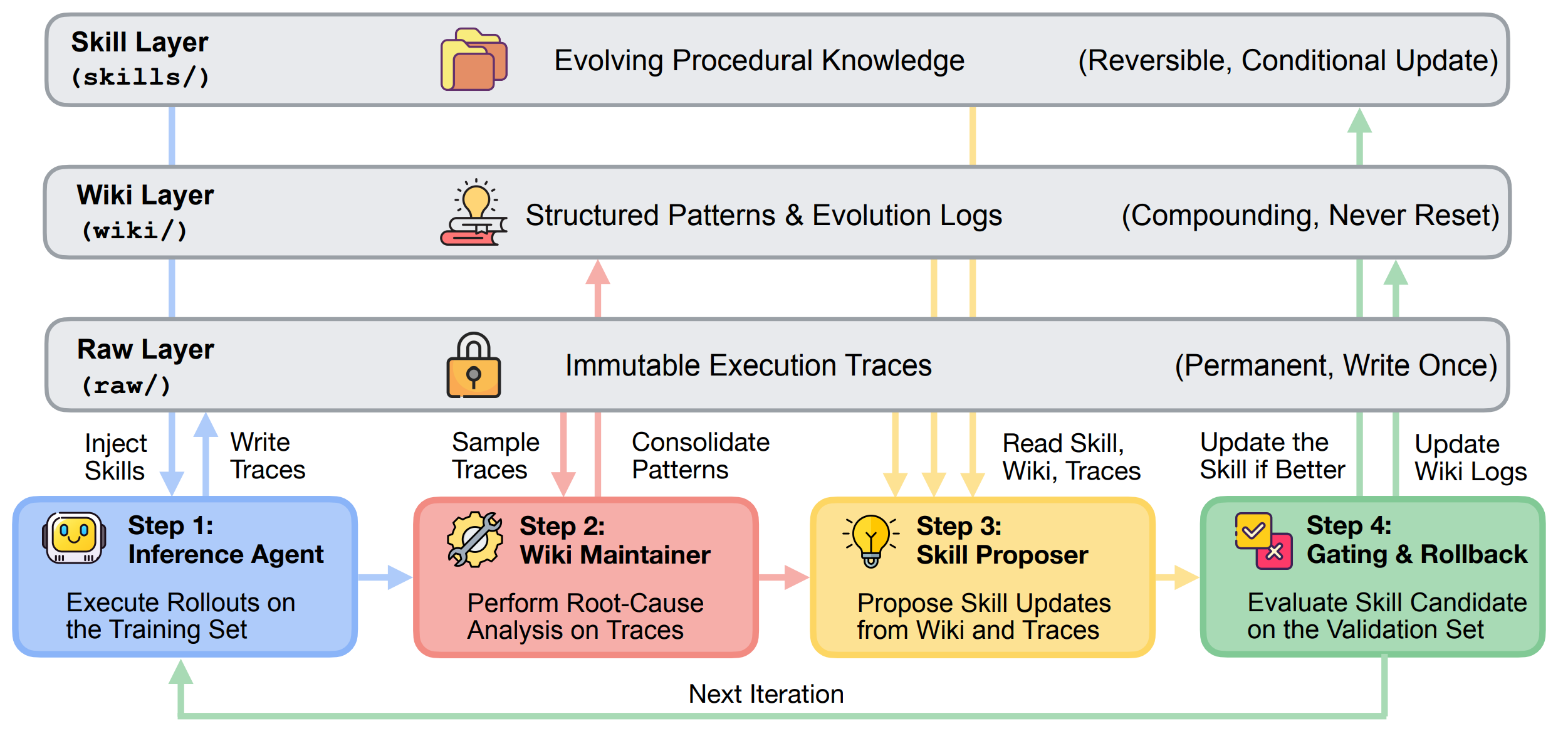
Researchers from Google and Virginia Tech propose WikiSkill, “a framework that co-evolves agent skills with a persistent knowledge base (wiki).” The agent workspace is divided into 3 layers: raw, wiki, and skill. The raw layer contains the agent’s execution traces from inference. Such traces are sampled to create a wiki layer, which contains consolidated patterns. Then, using both the wiki and raw layers, the skill layer is updated to reflect new knowledge. The authors show that WikiSkill outperforms other skill-evolution approaches like EvoSkill and SkillOpt.
Personal Thoughts
With the development of agents, creating and managing skills have become a crucial aspect of agent design. Given new knowledge, either from new experience or information provided by a user, the skill must be updated to reflect the new knowledge. I have been using a separate but similar approach of storing raw traces and then using them to update the wiki that the agent can consult, but perhaps this more structured approach of having a skill layer that is updated based on both the raw and wiki layers is more effective.
Read more
Reconstructing environments from trajectories
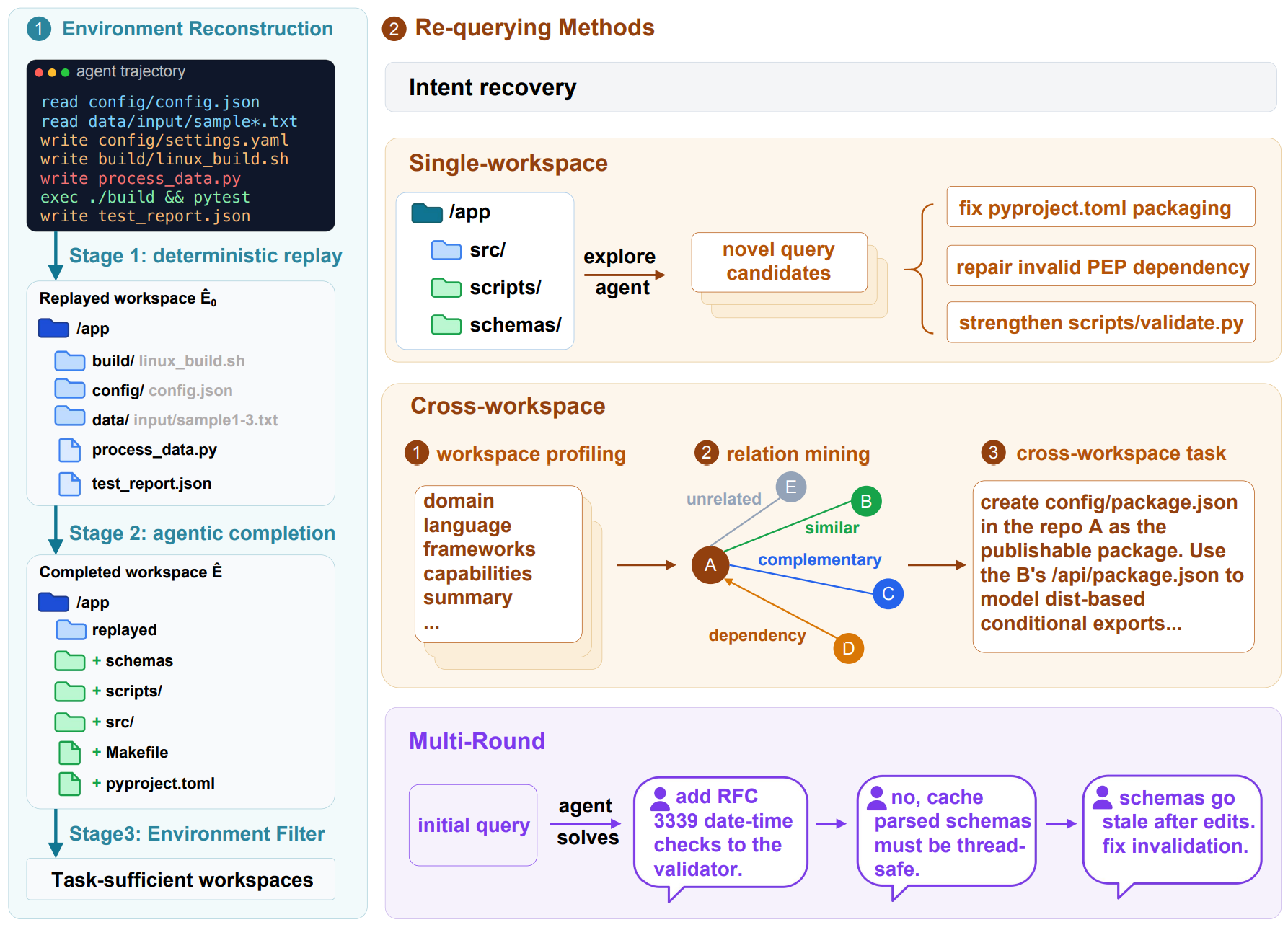
Researchers from the Qwen Team at Alibaba Group and Tsinghua University propose Terminal-Universe, “a framework which turns each trajectory into a reusable environment and explores it for synthesizing new tasks and continued interactions.” First, the read, write, and edit operations from the trajectories are used to reconstruct the environment, partially but deterministically. Then, given the partial workspace and the task, an agent fills in the gaps by creating and completing missing files and dependencies. A separate judge agent then inspects the completed workspace and the task to see if it contains enough context for an agent to complete the task. The workspaces can then be used to create new tasks within a single workspace or across multiple workspaces. The authors show that using reconstructed environments for fine-tuning outperforms imitating the raw trajectories.
Personal Thoughts
This is not an area of research I am familiar with, but it seems like a very interesting approach to fine-tuning agents when there is limited access to the original environment. The problem reminds me of offline RL.
Read more
One-liners
There is so much happening in the world of LLM agents. I am dividing it into industry news and research papers.
- Sakana AI announced Fugu Max and Fugu Ultra v2, which work by orchestrating multiple agents.
- GitHub now offers HydraFusion: a multi-model orchestration system for Copilot.
- Anthropic published a post about Claude formalizing the proof of Fermat’s Last Theorem.
- NVIDIA has agreed to acquire Hugging Face for nearly $13 billion.
- OpenAI announced that ChatGPT Ads reached a $1 billion annualized revenue run rate.
On the research side, here are some interesting papers:
- MNIST-PRO is a benchmark that reformulates the MNIST dataset as a sequential, glimpse-based search task with lookback constraints.
- Miles is an open RL library by RadixArk that supports post-training of various open-weight frontier models.
- ExecCritic separates the roles of test construction and source-code repair into two agents.
- ContextPilot frames proactive context management as an RL problem.
Subscribe to Agents in Practice
Get new issues of Agents in Practice — a newsletter summarizing exciting new research and applications in agentic AI — delivered to your inbox.